
Examining the Life of Forrest B. Henry, Inmate 5-AZ
A Life That Exists Mostly in Records
Forrest B. Henry is not remembered through narrative history. There are no detailed biographies, no recorded interviews, and no widely circulated accounts of his life before or after imprisonment.
What survives is a structured entry in the official Alcatraz inmate register.
He is listed as inmate 5-AZ, identified as an Army prisoner convicted of robbery and assault. That entry places him among the earliest documented individuals held on the island during its transition from a military prison to a federal penitentiary.
The record is brief, but it provides enough to trace his place within the larger system that defined Alcatraz.
Before Alcatraz: A Prisoner Within the Military System
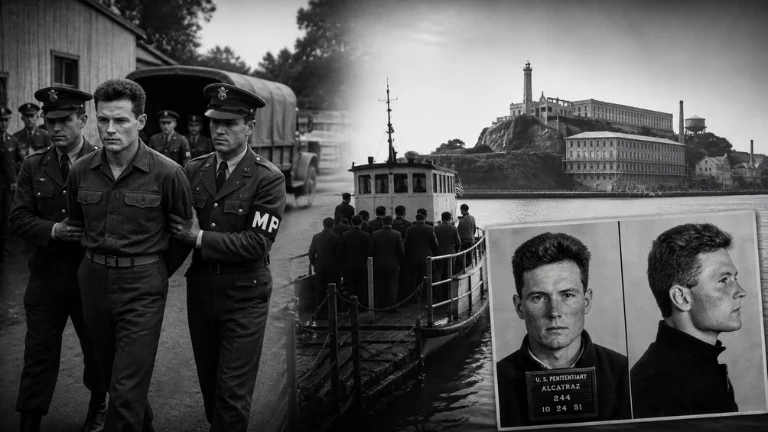
What Being an “Army Prisoner” Actually Meant
Forrest B. Henry was not part of the civilian criminal justice system at the time of his conviction.
As an Army prisoner, he was processed through the military legal system, which operated under its own courts, procedures, and disciplinary structure, most notably under frameworks like the Articles of War (before the introduction of the Uniform Code of Military Justice in 1950). Offenses such as robbery and assault were treated not only as crimes but also as violations of military order and authority.
This distinction matters.
A soldier convicted of serious offenses was not just seen as a criminal but as someone who had failed within a controlled system where discipline was central. That often resulted in stricter confinement compared to civilian prisons, with tighter supervision, reduced privileges, and a greater emphasis on order and compliance.
In practical terms, being an Army prisoner meant:
Court-martial conviction: Henry would have been tried by a military court (not a civilian judge and jury), where commanding officers played a direct role in the legal process.
Dual accountability: His actions were judged both as violations of law and as breaches of military duty, making the consequences more severe.
Structured imprisonment: Military prisons followed rigid daily routines—fixed schedules, mandatory labor, strict silence rules, and constant monitoring.
Limited rights and movement: Compared to civilian inmates, Army prisoners typically had fewer freedoms in communication, visitation, and personal autonomy.
Disciplinary escalation system: If a prisoner failed to comply or caused disruption, they could be transferred to more restrictive facilities.
This made the system less about rehabilitation and more about control, discipline, and correction within a hierarchical command structure.
Why His Case Led to Alcatraz
Not all military prisoners were sent to Alcatraz Federal Penitentiary.
The island was reserved for cases that required higher levels of control. This included prisoners who:
Presented disciplinary challenges
Required isolation from other inmates
Could not be managed effectively in standard military detention facilities
Alcatraz functioned as a final level of containment within the military prison network.
Henry’s transfer there indicates that his case met those criteria. Whether due to the nature of his offenses, behavior after conviction, or perceived risk, he was placed in an environment designed to limit movement and interaction as much as possible.
More specifically, being sent to Alcatraz suggests:
Failure in prior confinement: He was likely unable to adapt to standard military prisons or posed ongoing management issues.
Need for maximum control: Alcatraz enforced near-total regulation—locked cells for most of the day, controlled movement in small groups, and constant surveillance.
Isolation as a tool: Prisoners could be separated physically and socially to prevent influence, planning, or conflict.
Minimal tolerance for disruption: Even minor violations could result in severe consequences, including solitary confinement.
Alcatraz was not just another prison, it was a containment environment designed to remove risk entirely.
Henry’s placement there signals that authorities viewed him as someone who required the highest level of restriction available, placing him in a category of inmates who had moved beyond standard military discipline into extreme institutional control.
During Alcatraz: Life as Inmate 5-AZ
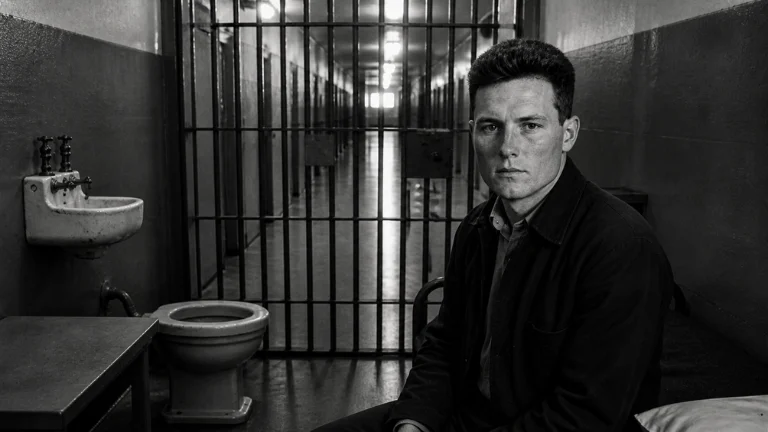
Arrival at a Prison in Transition
Forrest B. Henry entered Alcatraz during a period that is often overlooked.
The island was still under Army control, but preparations for its transfer to the Federal Bureau of Prisons were already underway. Administrative systems were being formalized, and the inmate register itself was part of that process.
His designation as inmate number 5 shows how early he arrived within that structured record.
This places him at a point where the prison’s identity was not yet fully defined. It was still functioning as a military detention facility, but the foundations of the federal system were beginning to appear.
Physical Conditions Inside the Cellhouse
The environment Henry experienced was already severe in its simplicity.
Cells measured approximately 9 feet in length, 5 feet in width, and 7 feet in height. The layout was consistent across the cellhouse, with no variation based on inmate status.
Each cell contained only the essentials:
A fixed bed
A narrow writing surface
A washbasin with running water
A toilet
There were no additional furnishings, no personal storage space beyond minimal allowances, and no attempt to create comfort.
The design limited both physical movement and personal control over the environment.
Daily Routine Under Military Control
Life on Alcatraz during the military period followed a strict but relatively simple structure.
The day was divided into defined segments:
Work assignments, often manual or maintenance-related
Scheduled meals
Periods of confinement within the cell block
Unlike the later federal system, there was no formal incentive structure. Prisoners did not earn privileges through behavior, and there were no structured rehabilitation programs.
The focus was on maintaining order and discipline.
This created a routine that was predictable but inflexible, with very little variation from day to day.
The Role of Isolation in Daily Life
The defining condition of Alcatraz during Henry’s time was isolation.
This operated on multiple levels.
Physically, the island separated prisoners from the mainland by cold water and strong currents. Contact with the outside world was limited, and communication with family was restricted.
Inside the prison, the structure reinforced separation further. Cells were individual, movement was controlled, and interaction between inmates was limited by design.
This combination created an environment where confinement extended beyond the cell itself.
Isolation was not just a feature of the prison. It was part of its purpose.
After Alcatraz: The Limits of What Survives

Why So Little Is Known
There is no detailed public record describing what happened to Forrest B. Henry after his time on Alcatraz.
This is a direct result of how records were maintained during the military period.
Documentation focused on:
Identification
Classification
Administrative tracking
Once a prisoner was discharged, transferred, or otherwise removed from the system, the need for detailed record-keeping diminished.
As a result, many early inmates, including Henry, appear clearly in the register but disappear from detailed documentation afterward
What Can Be Inferred From Similar Cases
While Henry’s individual outcome is not documented, patterns from similar cases provide some context.
Military prisoners held on Alcatraz during this period were typically:
Discharged after completing their sentence
Transferred to other facilities if needed
Released under military authority
In some cases, records simply note “released” or “discharged” without further detail.
Henry’s case likely followed one of these paths, but without direct documentation, the exact outcome remains unknown.
Why His Story Still Matters
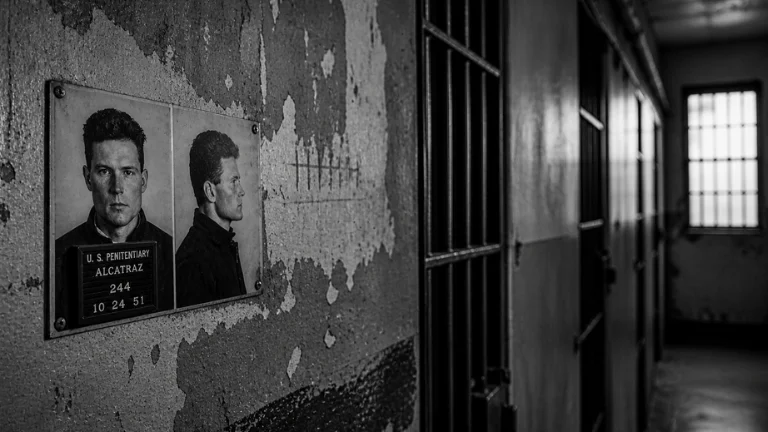
A View Into Early Alcatraz
Forrest B. Henry’s importance comes from where he appears in the record.
As inmate number 5, he is part of the earliest documented population on the island. His presence confirms that Alcatraz was already functioning as a high-control detention facility before it became a federal penitentiary.
This early phase is often overlooked, but it establishes the foundation for everything that followed.
What Visitors Gain From This Perspective
Understanding Henry’s place in history changes how visitors experience Alcatraz Island in San Francisco. Instead of seeing it as just a former prison, you begin to understand it as a system that evolved over time.
During an Alcatraz Day Tour in San Francisco, visitors are introduced to the island’s structured history, where stories are explained within the larger system of control and daily operations. This helps build a strong foundation for understanding how the prison functioned.
As the experience deepens, the Alcatraz Night Tour experience offers a more immersive perspective. The quieter environment and limited crowds allow visitors to connect with the isolation and atmosphere that defined life inside the prison.
For a more detailed understanding, a Behind the Scenes Alcatraz Tour gives access to additional areas and insights. It helps visitors see how the prison operated beyond what is typically shown, adding depth to the overall experience.
Henry represents the beginning of that documented system. His story may be limited, but it provides an important starting point, showing that every well-known narrative on Alcatraz is part of a much larger historical structure.
Final Takeaway
Forrest B. Henry’s life on record is minimal, but it is positioned at a critical moment.
He was part of Alcatraz before its most famous period, before its reputation was fully formed, and before its systems were standardized under federal control.
His story follows three clear stages:
A military conviction that placed him within a controlled system
Confinement on Alcatraz during its early institutional phase
A recorded presence that ends without detailed documentation
That pattern reflects how the prison operated.
It recorded what was necessary to manage people, but not enough to preserve their full stories.
Understanding that does not make the history more dramatic.
It makes it more complete.
Frequently Asked Questions
Who was Forrest B. Henry at Alcatraz?▾
What does inmate number 5-AZ mean at Alcatraz?▾
Was Forrest B. Henry a federal prisoner at Alcatraz?▾
Why was Forrest B. Henry sent to Alcatraz?▾
What was Alcatraz used for before 1934?▾
Why is there so little information about early Alcatraz inmates? ▾
What were conditions like for Army prisoners on Alcatraz?▾
Did early Alcatraz prisoners have the same rules as later inmates? ▾
What happened to Forrest B. Henry after Alcatraz? ▾
Why are lesser-known inmates like Forrest B. Henry important?▾
Adrian Davis
Published on Alcatraz Island Guide


