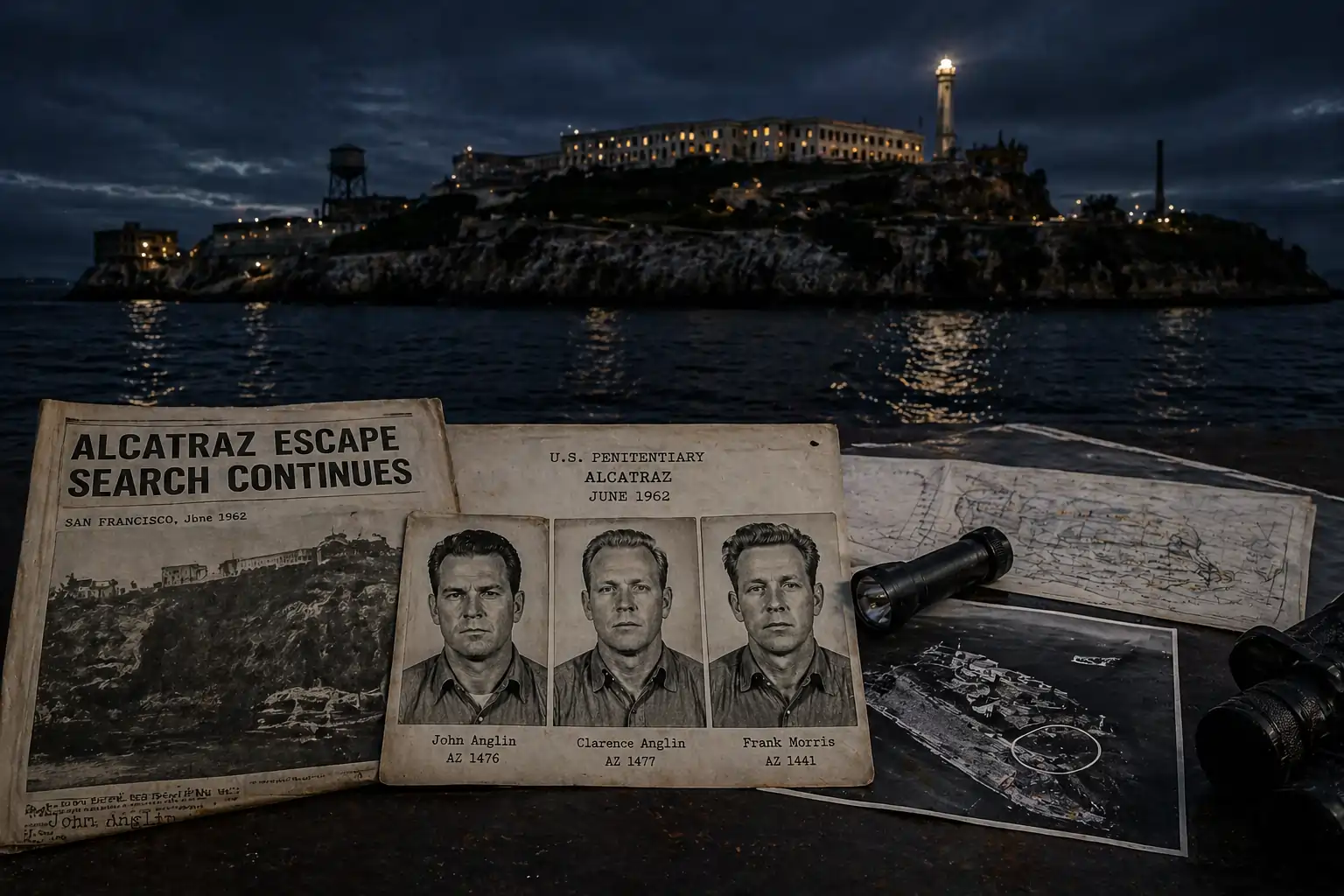
The June 1962 Alcatraz Escape: One of the Unsolved Case
Why This Escape Changes How You Experience Alcatraz
The June 1962 Alcatraz escape is the only unsolved case that directly changes how you interpret the island when you visit.
Alcatraz was built with a clear premise: isolation would prevent escape. Surrounded by cold water, strong currents, and distance from the mainland, it functioned more as a natural barrier than just a prison structure.
For nearly three decades, that system worked.
Then, on June 11, 1962, three inmates disappeared without a confirmed outcome. The escape was not detected until the next morning, creating a time gap of several hours between execution and response.
That delay, combined with the lack of physical evidence, is what turned this incident into an unresolved case rather than a closed one.
The Escape Did Not Start on the Night It Happened
Structural Weakness Inside the Cells
The starting point of the escape was not the night of June 11. It began months earlier with a structural observation.
Each cell had a ventilation opening covered by a metal grille. Behind that grille, the surrounding concrete had weakened over time due to constant exposure to moisture and salt air from the bay. The prison structure, built decades earlier, had not been reinforced in these specific areas.
The inmates tested the surface gradually and realized it could be removed with enough patience.
Instead of applying force, they worked in small increments. Using metal spoons and improvised tools, they chipped away at the weakened concrete. The work was slow, controlled, and repeated nightly. Over several months, the openings became large enough for a person to pass through.
The key detail is not just the method but the pace. Because the process was gradual, it avoided detection.
Concealment Strategy That Prevented Detection
The prison relied on visual inspection rather than physical verification during routine checks.
The inmates used that to their advantage.
After each session of digging, they covered the opening using cardboard panels painted to match the original wall surface. Under standard lighting conditions and during brief inspections, these covers appeared identical to the surrounding structure.
This worked because inspections were not designed to detect slow structural change. Guards were checking for movement, behavior, and visible damage, not subtle alterations behind a cell fixture.
The escape was built inside that gap between expectation and reality.
How They Managed to Leave Without Being Noticed
Night Checks and Timing Advantage
Leaving the cell required solving a second problem: presence.
Guards conducted night rounds, and each inmate needed to appear in place. If a bed looked empty, the alarm would have been immediate.
The inmates created dummy heads using soap, toilet paper, and real human hair collected from the barbershop. These were shaped and positioned to resemble a person lying in bed under low light conditions.
This method worked because of how inspections were conducted. Guards did not physically verify each inmate during night rounds. They relied on quick visual confirmation from a distance.
The result was critical.
The escape was not discovered until the morning count, giving the inmates a lead of approximately eight hours before any search began.
Movement Through the Internal Structure
Once outside their cells, the escape route shifted into parts of the prison not intended for inmate movement.
Above the cellhouse was a service corridor used for maintenance. This area was not actively monitored and provided space for movement and preparation.
From there, the inmates moved upward using exposed pipes and internal structures. They accessed a ventilation shaft that led to the roof, allowing them to exit the main building without passing through controlled checkpoints.
This route is important because it shows how the escape avoided the security system entirely. They did not break through locked doors or guarded paths. They moved through areas that were simply not part of the active security design.
The Real Challenge Was Not the prison; it was the water.
Why Crossing the Bay Was Critical
Escaping the building did not mean success. The island itself was the real barrier.
San Francisco Bay presents multiple physical challenges:
Water temperatures between 50 and 55°F (10–13°C)
Strong and shifting tidal currents
Exposure to wind that increases heat loss
At those temperatures, hypothermia can begin quickly, even for strong swimmers. Movement becomes difficult, and survival depends heavily on insulation and flotation.
The inmates understood this.
Construction of the Raft and Survival Planning
To solve the water problem, they built a raft using materials available inside the prison.
Over time, more than 50 raincoats were collected and stitched together to create an inflatable structure. When sealed properly, the material could hold air and provide flotation.
Inflation was achieved using a modified concertina, which functioned as a manual pump. This allowed them to prepare the raft without drawing attention through noise or unusual activity.
This part of the escape required planning beyond the prison itself. It shows an understanding of buoyancy, temperature risk, and the need for controlled movement in water.
The raft was not optional. Without it, the escape would likely have ended at the shoreline.
Why This Story Matters When You Visit
What You Should Focus on During the Tour
When you walk through Alcatraz, the escape becomes easier to understand if you follow its actual sequence.
Start inside the cellhouse and observe the rear walls of the cells. Notice how the structure differs from what you would expect in a modern high-security facility.
Then shift your attention upward and consider the space above the cells, where movement was possible without detection.
Finally, step outside and look toward the water. This is where the final and most uncertain part of the escape begins.
The story only makes sense when you connect these three layers:
cell → structure → shoreline.
Choosing the Right Tour for This Experience
Different tours shape how clearly you understand this sequence.
The Alcatraz Day Tour gives you time and visibility, making it easier to follow the escape step by step without pressure.
The Alcatraz Night Tour changes the environment. Reduced light and fewer visitors make the cellhouse feel closer to how it would have been during the escape, especially during the critical night phase.
The Alcatraz Behind the Scenes Tour adds structural access and explanation, helping you understand how the internal movement actually worked beyond what is visible on the main route.
The difference is not in the story itself, but in how clearly you can connect its stages.
Why the Escape Remains Unresolved
The reason this case still stands out is not how the escape was executed, but what happened after.
No bodies were recovered.
No confirmed sightings were verified.
The official conclusion was based on probability rather than direct evidence.
This leaves the outcome open.
The escape was successful inside the prison.
What happened beyond the shoreline remains unknown.
That uncertainty is what keeps the Anglin Brothers Escape from Alcatraz relevant, both historically and for visitors experiencing the island today.
The Night of June 11, 1962: How the Escape Actually Unfolded
The Final Preparation Before Lights Out
By the time June 11 arrived, the escape was no longer a plan. It was a sequence ready to be executed.
The openings behind the cells were complete. The raft had already been assembled in sections and hidden in the service corridor above the cellhouse. Dummy heads were prepared and ready to be placed.
Nothing was being created that night. Everything had already been tested and positioned in advance.
This is an important distinction. The success of the escape depended on reducing risk during execution. Any delay or mistake during that final night could have exposed the entire operation.
Leaving the Cells Without Triggering Suspicion
At approximately 9:30 PM, lights were turned off in the cellhouse. Shortly after, the inmates placed the dummy heads in their beds, arranged blankets to simulate sleeping bodies, and moved through the openings behind their cells.
The movement had to be quiet and controlled. Sound travels easily through the cellhouse structure, and even a minor disturbance could have drawn attention.
Once inside the service corridor, they were no longer visible from the main prison level.
At this stage, the escape had already passed its most critical detection point. The system designed to keep inmates in place had been bypassed without alert.
Movement Through the Structure and Access to the Roof
From the corridor, the inmates moved upward through the building using exposed pipes and structural supports.
They reached a ventilation shaft that led to the roof of the cellhouse.
This part of the escape required physical coordination and familiarity with the structure. The route was not obvious and would have been difficult to navigate without prior planning.
Once on the roof, they crossed the top of the building and located a path down toward the shoreline.
This was the first stage where exposure increased. Unlike the internal movement, the roof offered little cover. The success of this step depended heavily on timing and low visibility.
Reaching the Shoreline and Entering the Bay
The Location and Intended Route
The inmates reached the northeastern side of the island. This location was not chosen randomly.
From there, their intended path was:
First toward Angel Island
Then onward to the Marin County shoreline
This route aligned with tidal patterns that could assist movement if timed correctly.
The distance to Angel Island is roughly 1.25 miles (2 km), but distance alone does not define difficulty. The direction and strength of currents play a larger role in determining whether a crossing is possible.
Launch Timing and Water Conditions
They entered the water at night, likely before midnight.
Timing was critical because of tidal shifts.
San Francisco Bay operates on a cycle where currents change direction based on incoming and outgoing tides. If they entered too late, outgoing currents could have pulled them away from land and into open water.
Water temperature that night was estimated between 50 and 55°F (10–13°C). At this range, cold shock and hypothermia become serious risks within a short period.
Even with a raft, exposure to cold water and wind could reduce physical control over time.
This is where the escape moves from controlled planning to environmental uncertainty.
When the Escape Was Discovered and Why It Mattered
Morning Count and Delay in Response
The escape was discovered during the morning count on June 12.
Guards approached the cells expecting to wake the inmates and instead found the dummy heads in place.
By that point, several hours had already passed since the escape.
This delay is one of the most important factors in the entire case.
Unlike most escape attempts, which are detected quickly, this one provided a significant head start. The inmates were already far beyond immediate reach before any search began.
Initial Search and Lack of Immediate Evidence
A full search operation was launched, covering:
The island
Surrounding waters
Nearby shorelines
Despite this, no direct trace of the inmates was found.
Only partial evidence appeared in the following days, including items linked to the raft and personal belongings.
There were no confirmed signs of survival or death.
This lack of immediate resolution is what shifted the case from a standard escape into an ongoing investigation.
Investigation Findings and Conflicting Conclusions
The Official FBI Position
The FBI concluded in 1979 that the inmates most likely drowned.
This conclusion was based on environmental conditions:
Cold water temperatures
Strong tidal currents
Physical demands of crossing the bay
From a probability standpoint, the conditions made survival difficult.
However, the conclusion was not supported by direct physical evidence. It relied on likelihood rather than confirmation.
Why the Case Remained Open Longer
The U.S. Marshals Service continued the investigation for decades after the FBI closed it.
The reason was simple.
There was no conclusive proof of death.
No bodies were recovered.
No verified sightings were confirmed.
No definitive evidence placed the inmates at a final location.
The case remained open until 2015, reflecting how uncertain the outcome actually was.
Survival vs Drowning: What the Evidence Actually Suggests
Why Drowning Was Considered Likely
The conditions in the bay present real challenges.
Cold water reduces body temperature quickly. Strong currents make direction control difficult. Fatigue becomes a major factor even with flotation.
From an investigative standpoint, these factors support the assumption that survival was unlikely.
Why Survival Cannot Be Ruled Out
Later analysis introduced a different perspective.
Studies of tidal patterns showed that under specific timing conditions, currents could have helped carry a raft toward the Marin shoreline rather than away from it.
If the inmates entered the water before a certain tidal shift, the movement of water could have worked in their favor.
This does not confirm survival, but it establishes that survival was physically possible.
That distinction is important.
What Visitors Often Misunderstand About the Escape
Most visitors focus on how the inmates left the prison.
That part is now well understood.
The uncertainty lies entirely in what happened after they reached the water.
The escape itself is not the mystery.
The outcome is.
When you stand on the island and look at the bay, that difference becomes clear.
The prison was a controlled environment.
The water was not.
Timeline of the Anglin Brothers Escape
From Planning to Disappearance
The escape was not a single event. It was a sequence built over several months and executed in a narrow window of time.
Late 1961 — Frank Morris and the Anglin brothers begin testing the concrete behind their cells. Digging starts gradually using improvised tools.
Early 1962 — Raincoats begin disappearing from the prison system. The raft and life vests are assembled in parts inside the service corridor.
Spring 1962 — Dummy heads are created and refined to pass night inspections.
June 11, 1962 (9:30 PM) — Lights out. The inmates exit their cells and enter the service corridor.
Late night — Movement through the building leads to the roof and then down toward the shoreline.
Night of June 11 — The raft is inflated and launched into San Francisco Bay.
Morning of June 12 — Guards discover the escape during routine count.
1979 — FBI closes the case, stating probable drowning.
2015 — U.S. Marshals Service ends investigation without a confirmed outcome.
This timeline highlights one key point. The escape itself was precise. The uncertainty begins only after the inmates entered the water.
What You Can Actually See During Your Visit
Inside the Cellhouse
When you enter the cellhouse, you can see the original cells used by the Anglin brothers and Frank Morris.
The ventilation openings behind these cells are still visible. Standing there, it becomes clear how close the inmates were to the hidden space behind the walls.
The layout of the cell block also explains how communication between adjacent cells was possible, which played a role in coordination.
The Structure Above the Cells
While not all areas are directly accessible, the design of the building allows you to understand how a service corridor exists above the cellhouse.
This is where the inmates:
Moved after leaving their cells
Stored materials
Assembled the raft
Seeing the vertical structure of the building helps connect how movement from cell to roof was possible without crossing guarded paths.
The Shoreline and the Bay
The most important perspective comes from outside.
When you walk toward the edge of the island, you see the distance to Angel Island and the open water beyond.
This is where the final stage of the escape becomes real.
From this point, you are no longer thinking about prison design. You are thinking about distance, current, and survival.
How to Experience This Story Properly on Your Tour
Follow the Escape in Sequence
To fully understand the escape, it helps to follow it in the same order it happened.
Start inside the cellhouse and focus on the rear wall of the cells. From there, shift your attention to how the building extends above and around you.
Finally, step outside and look toward the water.
This sequence matters because each stage explains the next. Viewing them out of order makes the escape feel disconnected.
Give Yourself Enough Time
The escape is not something you understand in five minutes.
You need time to:
Observe the cells closely
Walk through the building
Stand at the shoreline and process the final step
This is why the Alcatraz Day Tour works well for most visitors. It gives you enough flexibility to move at your own pace and connect each part of the story.
If you prefer a quieter environment, the Alcatraz Night Tour reduces crowd noise and changes the atmosphere, which can make the escape easier to visualize.
The Alcatraz Behind the Scenes Tour adds more structural detail, helping you understand how movement inside the prison actually worked.
Key Facts That Define the Escape
The following details explain why this escape is still discussed today:
The preparation period lasted roughly six to eight months
The escape was not discovered until the following morning
The inmates gained several hours before any search began
The raft was constructed entirely from materials available inside the prison
No confirmed remains were ever recovered
These are not minor details. Each one contributed to the escape becoming unresolved rather than closed.
Final Answer: What Happened to the Anglin Brothers
There is no confirmed conclusion.
The official position suggests they likely drowned due to environmental conditions.
However:
No physical evidence confirms that conclusion
Later analysis shows survival was possible under specific timing conditions
The escape itself is established fact.
The outcome remains uncertain.
Final Takeaway for Visitors
The Anglin Brothers Escape from Alcatraz is not just something you learn during the tour. It is something you interpret.Inside the cellhouse, the escape feels calculated and controlled.
At the shoreline, it feels uncertain.
That contrast is what defines the experience.If you approach your visit with that in mind, the island stops being just a historic site and becomes a place where a question still has no clear answer.
Frequently Asked Questions
Who were the Anglin brothers at Alcatraz?▾
When did the Anglin brothers escape from Alcatraz?▾
How did the Anglin brothers escape from Alcatraz?▾
Did the Anglin brothers survive the escape?▾
Who helped the Anglin brothers escape?▾
How long did it take to plan the Alcatraz escape?▾
What was the raft made of in the Alcatraz escape?▾
Why was the escape not discovered immediately?▾
What makes the Anglin brothers escape different from other attempts?▾
Can you see where the Anglin brothers escaped during a visit?▾
Sierra
Published on Alcatraz Island Guide


